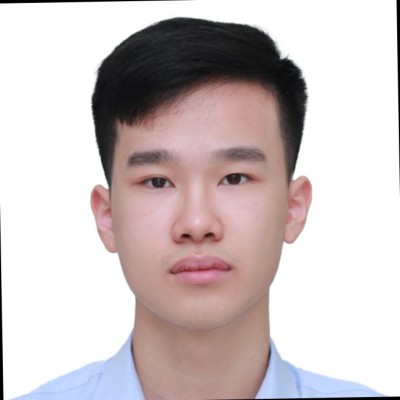
I am a PhD student in Computer Science at Texas A&M University, advised by Ricardo Gutierrez-Osuna. Previously, I received my B.A. in Computer Science and Mathematics from Bucknell University, where I worked with Rajesh Kumar.
I am interested in human-computer interaction (HCI) and AI for healthcare. My current research focuses on wearable health sensing: I am developing methods to measure arterial blood flow with a quad-sensor TAG system worn on the wrist, which captures how the artery dilates as each pulse of blood passes through.
During my undergraduate studies, I worked on biometric technologies and trustworthy AI: (1) understanding how generative models threaten biometric systems and how to defend against them, and (2) using behavioral signals such as keystroke dynamics to detect LLM-assisted writing.
Before starting my PhD, I was a Robotics AI Engineer at Viettel Institute of Strategic Industrial Technology (Summer 2026), where I built an on-device Vietnamese speech recognition and LiDAR–camera perception pipeline for a quadruped robot. I was also an AI Research Intern at Knovel Engineering (2025–2026), working on chain-of-thought reasoning for medical visual question answering.
Selected Publications
* denotes equal contribution
Summary
We introduce a Vietnamese keystroke dataset covering bona fide composition, transcription, and paraphrasing, and a threat model in which users deliberately alter their typing to evade detection. Sequential models outperform feature-based approaches, and adversarial training with manipulated data improves robustness.
Summary
We propose interpretable keystroke features (pauses, bursts, timing irregularities) to detect LLM-assisted writing in Korean across cognitive levels of Bloom's taxonomy, reaching 85%+ accuracy on 69 users while remaining explainable.
Summary
We show that signatures forged by conditional GANs and VAEs raise the false acceptance rate of signature verification models from 3% to 25%, introduce an SSIM-based metric that explains attack success, and use adversarial training to bring attack success back under 3%.
Selected Preprints
Summary
We present S-Chain, a medical dataset for structured visual chain-of-thought reasoning. Training medical vision-language models on S-Chain improves both their accuracy and explainability.
Earlier Work
- Y. T. T. Hai, A. Ngo, N. Q. Dat, V. K. Solanki. Multi-input LSTM for water level forecasting in Black River at the border of Vietnam–China. ICMLANT 2021.
- A. Ngo, N. N. Minh, N. Q. Dat, V. K. Solanki. Hybrid model Seasonal ARIMA-LSTM for prediction water level in Black River on the border Vietnam–China. Computational Intelligence in Machine Learning: Select Proceedings of ICCIML 2021.